Shopping Cart
There are no more items in your cart

Key takeaways
UK law controls THC; a “hemp” or “CBD” label does not establish an exemption. The Home Office factsheet requires all three exempt-product conditions: purpose, recoverability and quantity. Its 1mg threshold applies to each controlled drug in the container, not a typical dose. Medical and food rules also require separate consideration.
Sources for this summary checked on 29 September 2026.
This guide covers THC gummies, cannabis edibles and legal distinctions. See also the guide to THC edible effects and precautions.
Table of contents
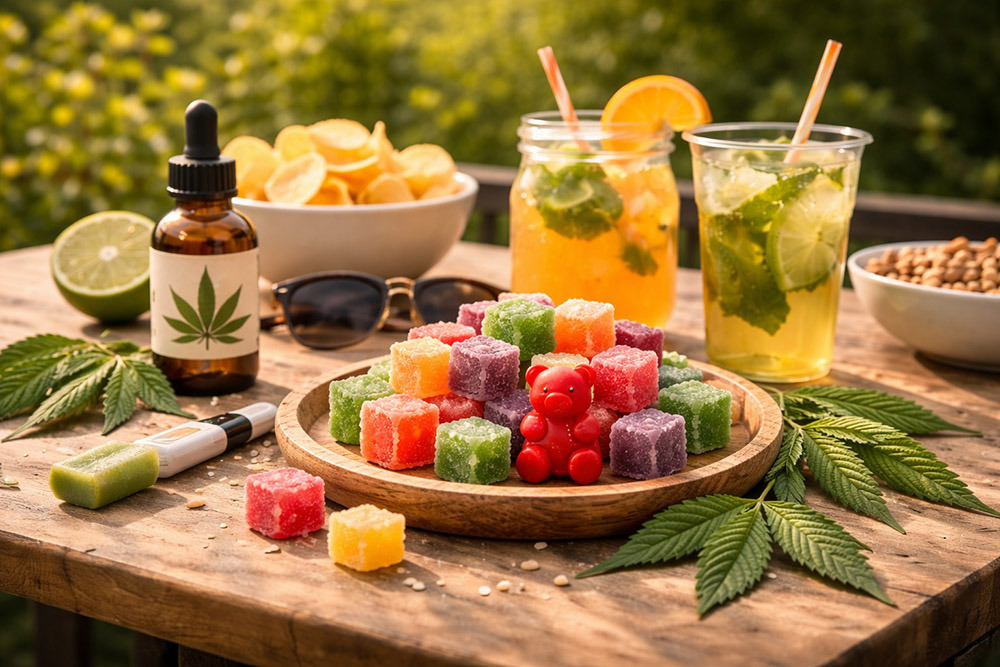
THC gummies are food products infused with tetrahydrocannabinol, the main psychoactive compound in the cannabis plant. They sit within the larger category of cannabis edibles, which can also include baked goods, THC infused brownies, chocolates, capsules, oils, and drink products infused with cannabinoids. [1][6][7]
In plain terms, THC gummies and other THC edibles are edible versions of cannabis. Instead of inhaling smoke from regular cannabis flower, users consume food products that contain THC content measured by dose, serving size, or total amount per pack. [1][6]
This is one reason edibles in the UK have become increasingly popular in online discussion. Many users see them as more discreet than smoking, and some prefer them because they want to avoid smoke exposure, lung irritation, or broader concerns about lung inflammation linked to inhaled cannabis use. That does not make THC gummies legal, but it helps explain why cannabis edibles have gained popularity. [3][6][7]
CBD gummies and CBD edibles are different. CBD is a non psychoactive compound, or more precisely a non intoxicating cannabinoid, while THC is the psychoactive compound that causes the classic “high.” That distinction matters for both legal status and safety. [1][3][4]
THC edibles pass through the digestive system before entering the bloodstream. That is why the onset is slower than inhaled cannabis and why the experience often feels different from smoking. Barrus and colleagues note that edible cannabis has a delayed onset and can be harder for users to dose correctly, especially when product labeling is unclear. [6]
This delayed onset matters because it changes how much THC feels manageable. Someone may take a lower dose, feel nothing for a while, and then take more before the first dose has fully taken effect. That is one reason too much THC is a common problem with THC edibles compared with other cannabis products. [6][7]
In the body, THC and CBD follow different pharmacological paths. CBD and THC are both cannabinoids from the cannabis plant, but THC drives intoxication while CBD does not. NHS England describes THC as the major psychoactive constituent of cannabis and notes that pure CBD is not psychoactive. [3][4]
Because edible products act more slowly, people should not judge effect based only on the first 20 or 30 minutes. A harm-reduction approach is to assume a delayed onset, avoid stacking doses quickly, and pay attention to THC content, other cannabinoids, and the total amount in the container. [5][6]
For most adults, the answer to “are THC gummies legal” is no. Under UK law, cannabis is a Class B drug, and THC is a controlled cannabinoid. The Home Office states that cannabis is a Class B controlled drug under the Misuse of Drugs Act 1971, and that THC is one of the controlled cannabinoids covered by that framework. [1]
That means THC gummies are not legal for recreational use, and UK regulations do not allow everyday non-medical purchase of THC edibles. Outside the medical route, possession, supply, production, import, or export of cannabis and THC-containing products is unlawful unless a specific exemption or licence applies. [1][3]
Whether an edible is legal in the UK therefore depends entirely on what it contains. Cannabis edibles are not legal for general recreational use, and most THC products remain illegal outside regulated medical purposes. [1][2][3]
That is also why “buy THC gummies” is not a normal legal consumer question in the UK. If someone wants to buy THC gummies for recreational use, the likely options are the black market or unregulated sellers, and NHS guidance warns that cannabis-based products sold online without prescription are likely illegal to possess or supply and may not be safe to use. [3]
| Product | UK status as described in this guide |
|---|---|
| THC gummies and other THC edibles (recreational) | Controlled: possession, supply, production, import or export is unlawful unless a specific exemption or licence applies |
| Prescribed cannabis-based medicines | Legal since 1 November 2018 when prescribed by a specialist doctor on the GMC Specialist Register |
| Pure isolated CBD | Not controlled under the Misuse of Drugs Act |
| CBD edibles, gummies and oils | Depend on the finished product: all three Home Office exempt-product conditions (purpose, recoverability, quantity) plus food law |
| Cannabis-based products sold online without prescription | NHS: likely illegal to possess or supply, and may not be safe to use |
Medical cannabis has been legal in a limited form since 1 November 2018. The Department of Health and Social Care states that from that date, doctors on the General Medical Council Specialist Register have been able to prescribe cannabis-based products for medicinal use where clinically appropriate and in the patient’s best interests. [2]
This is where legal access exists. For adults asking whether THC gummies can be obtained legally through a medical route, the better question is whether a prescribed cannabis-based product can provide legal access. Under the UK framework, legal access comes through a medical cannabis prescription, not general retail. [1][2][4]
NHS guidance says cannabis-based medicine can only be prescribed on the NHS by a specialist hospital doctor, or under a specialist’s supervision, and only for a small number of patients. It names rare epilepsies, MS-related spasticity, and chemotherapy-related nausea as the clearest NHS examples. [3]
NHS England adds an important detail for private care. Private doctors on the GMC Specialist Register are legally able to prescribe cannabis-based products for medicinal use as well, which is why some adults explore a private specialist route through what they informally call a licensed clinic. The legal requirement, however, is about the specialist prescriber rather than a simple retail clinic model. [4]
In practice, medicinal cannabis is not the same as over-the-counter THC gummies. Cannabis based products for medicinal use are regulated as medical products, may be unlicensed special medicines, and are not the same as casual edible options sold as lifestyle products. [1][4]
Original packaging also matters for patients with a prescription. The NHS advises people to keep medical cannabis in original packaging and retain prescription evidence because the dispensing label contains important information. [3]
Whether CBD edibles are legal is a more nuanced question, but the short answer is that many CBD edibles are legal in the UK if they comply with food and controlled-drug rules. CBD itself is not controlled in pure isolated form under the Misuse of Drugs Act, but CBD products can still be problematic if they contain controlled cannabinoids such as THC. [1][4]
The Home Office’s exempt-product guidance requires all three conditions to be met; the quantity threshold alone does not establish legality.
An exemption under drug legislation does not establish compliance with food law. The two questions require separate checks.
CBD gummies, CBD oil, and other CBD products are therefore only legal in the UK when they comply with UK regulations on controlled cannabinoids and food law. Because trace amounts can still appear, legal status depends on the finished product, not just the front-label claim that it is CBD. [1][5]
Debates about the law on THC edibles often mention health. For prescribed medical cannabis, NHS and NHS England sources list specific uses such as treatment-resistant epilepsy, spasticity in MS and chemotherapy-related nausea. [3][4] These are prescribed medicines, not consumer THC gummies: no medical benefit has been established for such products, and they are not a treatment.
For chronic pain, the evidence is weaker. NHS England notes that there is not enough strong evidence yet to recommend cannabis-based products broadly for chronic pain, and NHS guidance says medical cannabis may sometimes be considered in pain research contexts, but it is not a routine NHS answer for chronic pain. [3][4]
Scientific research is still developing. That is why many cannabis based products remain tightly controlled, why many THC products are unlicensed in medical settings, and why prescribers are expected to consider both benefits and harms carefully. [2][4][7]
Potential risks are just as important. NHS guidance warns that products containing THC may carry risks such as psychosis, dependency, dizziness, hallucinations, mood changes, and interactions with other medicines. It also states that, generally, the more THC a product contains, the greater these risks are. [3]
That matters for non medical users too. With THC edibles, delayed onset increases the chance of taking too much THC, and unregulated products may have unclear THC content. Many users choose edible products for convenience, but convenience does not reduce the need for caution. [3][6]
A harm-reduction approach begins with the legal question. If a product contains THC and is not prescribed, assume it may be illegal in the UK. If it claims to be CBD, do not assume it is automatically compliant, especially if the THC content, other cannabinoids, or lab results are unclear. [1][3][5]
For prescribed medical cannabis, follow the specialist doctor’s instructions and the recommended dosage on the prescription. Keep the product in original packaging, and do not treat prescribed medicinal cannabis as interchangeable with black market edible options. [3][4]
A manufacturer’s identity and product composition are relevant information, but a label alone does not prove compliance.
Finally, remember that personal preferences do not change the law. Some adults prefer drink products infused with cannabinoids, some prefer baked goods, and some prefer CBD gummies. But whether something is legal in the UK depends on the formulation, not on the format. [1][5]
For recreational use, no. THC gummies are not available for general non-medical purchase in the UK, because THC is a controlled cannabinoid and cannabis is a Class B drug under the Misuse of Drugs Act 1971. [1][3]
For most adults, not as ordinary consumer products. Legal access to THC-containing cannabis based products is through prescription channels, not standard retail. That is why “buy THC gummies” is not the same as buying CBD gummies or CBD oil. [2][3][4]
CBD food products must satisfy applicable food requirements and, where controlled cannabinoids are present, the relevant drug-law conditions. Pure isolated CBD is not controlled under the Misuse of Drugs Act, but a product containing THC can still be a problem, so legal status depends on the finished product. [1][5]
Yes, but under strict rules. Medical cannabis prescription decisions must be made by a specialist doctor, and access remains limited. [2][3][4]
Know the THC content, expect delayed onset, avoid taking too much THC too quickly, and do not assume that every claim that an edible is legal is accurate. With edibles in the UK, the difference between legal and illegal often comes down to prescription status, trace amounts, and product compliance. [1][5][6]
Are THC gummies legal? In the UK, THC gummies are generally illegal for recreational use, while legal access to THC-containing cannabis based products exists only through tightly regulated medical cannabis routes. That is the key point behind questions about the legal status of THC edibles. [1][2][4]
Do not treat 1mg as a blanket permission to sell CBD edibles. See the Home Office’s full exempt-product conditions.
For adults trying to navigate cannabis laws, the safest takeaway is simple: separate medicinal cannabis from recreational use, separate pure CBD from THC products, and treat online claims carefully. In this area, legality depends on formulation, prescription status, and UK regulations, not on marketing language or product popularity. [1][3][4][5]
Official references: Home Office: cannabis, CBD and other cannabinoids; GOV.UK: medicinal cannabis resources.