Shopping Cart
There are no more items in your cart

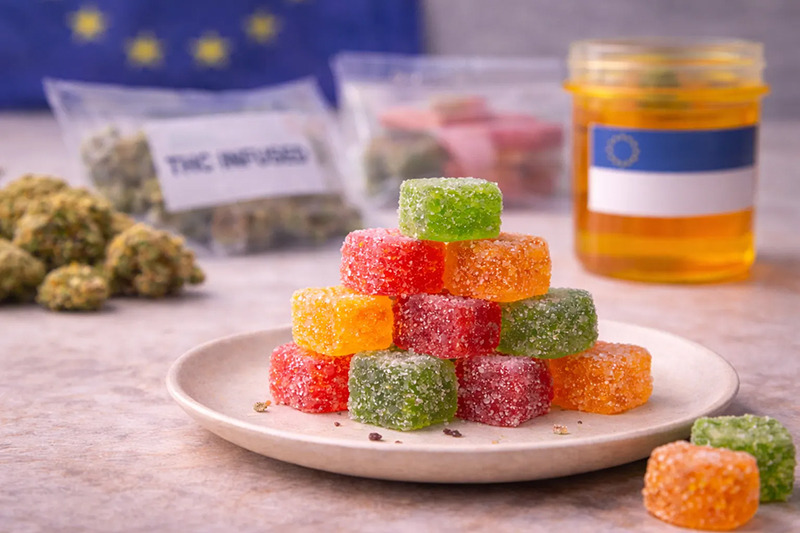
THC gummies are gummy sweets that contain a measured dose of THC, the main psychoactive compound in cannabis, for example 10 mg per piece. Because the THC is digested and then metabolized in the liver, effects start later than with smoking, usually after 30 minutes to 2 hours, and last several hours. The labeled dose per gummy is the key safety information.
Key takeaways
THC gummies are a widely discussed form of edible cannabis among adults in Europe. As cannabis edibles become increasingly popular, many people want clear information about how THC gummies work, how THC edibles legal status is defined, and how edibles affect the body under different cannabis laws. Unlike smoking, THC gummies are consumed orally, which changes both potency and duration.
Because THC gummies are edible gummies, their psychoactive effects, THC levels, and long lasting effects vary based on consumption, metabolism, and product quality. This makes them different from other marijuana edibles and baked goods. Understanding these differences is essential for harm reduction, especially for first time users and new users.
This article explains THC gummies, cannabis gummies, and THC edibles in an educational and neutral way. It focuses on dosage, cannabinoids, legal context and potential side effects, without giving medical advice.
Table of contents
Cannabis edibles are food products infused with cannabinoids from cannabis extracts. They include gummies, other sweets and baked goods. Edible cannabis differs from smoking because THC is absorbed through digestion rather than inhalation.
When cannabis edibles are consumed, they affect the body more slowly, but often with stronger and long lasting effects. This varies based on THC levels, metabolism, and whether consumption occurs on an empty stomach or after food [1].
Cannabis edibles are increasingly popular among adults seeking clear headed consumption without smoke. However, because effects vary based on individual biology, recommended dosage and patience are essential.
Cannabis gummies are a specific type of cannabis edible. These gummies are often chosen because of their consistent texture, smooth feel, and measured portions.
Cannabis gummies may contain regular THC, delta 9 THC, or blends of THC and CBD. The mix of cannabinoids changes how the overall effect is experienced. Product quality and lab tested manufacturing strongly influence the experience [2].
Because cannabis gummies resemble sweets, storage is important to avoid accidental consumption, especially by first time users.
Which THC gummies suit a person depends on individual tolerance, experience and goals. Some people prefer low dose THC gummies for a clear headed effect, while experienced users may seek high potency products.
Factors include flavor, consistent texture, THC levels and whether products are lab tested. Taste, including citrus or berry notes, makes consumption more pleasant but does not indicate potency.
From a harm reduction perspective, the most suitable THC gummies are those with clear labeling, predictable THC levels, and reliable product quality rather than maximum strength alone.
Cannabis infused oil is the base used in many THC products. Cannabis extracts are infused into oil, which is then used to make edible gummies or baked goods.
This process allows cannabinoids to bind with fats, improving absorption during digestion. The quality of cannabis infused oil affects potency, smoothness, taste, and overall consumption experience [3].
Accurate formulation ensures consistent texture and stable THC levels across gummies.
Edible gummies are THC edibles designed for oral consumption. Unlike smoking, edible gummies pass through the digestive system before THC enters the bloodstream.
This explains why edible gummies have delayed onset and long lasting effects. Edibles affect individuals differently, and effects vary based on how much THC is consumed.
| Feature | THC gummies (eaten) | Smoked or vaped cannabis |
|---|---|---|
| Absorption | Digestive system, then metabolized in the liver | Inhalation, no digestion |
| Onset | 30 minutes to 2 hours | Faster |
| Duration | Several hours, sometimes into the next day | Shorter |
| Dosing | Set mg of THC per gummy on the label | Harder to standardize |
Edible gummies are often compared to other marijuana edibles, but gummies stand out for standardization and ease of consumption.
Gummy edibles are increasingly popular among both new users and experienced users. Their appeal comes from flavor variety, smooth texture, and discreet use.
However, gummy edibles also carry risks. Because onset is delayed, consuming additional doses too quickly can increase anxiety and other potential side effects [4].
Harm reduction focuses on recommended dosage, patience, and understanding how potency varies based on the product.
Full spectrum THC gummies contain THC along with CBD and other cannabinoids found in cannabis extracts.
Some users report a different experience when THC and CBD are combined, but evidence is still developing [5]. No medical benefit has been established for these products; they are not a treatment.
Full spectrum does not remove psychoactive effects or eliminate risks related to THC consumption.
CBD gummies contain cannabidiol and are not psychoactive. However, some THC products combine THC and CBD in the same edible.
CBD alone does not cause intoxication. When THC and CBD are combined, the THC still produces psychoactive effects, and the ratio between the two changes the overall experience.
Understanding THC and CBD ratios helps consumers compare THC gummies and CBD gummies.
Fruity flavors such as blueberry are a common example of flavor variety. Flavor affects taste and enjoyment but does not change THC levels or potency.
Flavors such as blueberry or citrus can mask the taste of cannabis infused oil, making gummies more delicious.
Even smooth and flavorful gummies can contain high potency THC and produce strong psychoactive effects.
Delta 9 THC is the primary psychoactive compound in cannabis. It is responsible for the psychoactive effects associated with THC gummies and other THC edibles [1].
When delta 9 THC is consumed in edible form, it is metabolized in the liver, contributing to long lasting effects and increased potency compared to inhalation.
Understanding delta 9 THC helps explain how much THC is consumed and why effects vary based on individual metabolism.
The right potency depends on tolerance, experience and intended effects. Some adults seek clear-headed effects, while others prefer evening use.
High potency products are not always suitable for first time users. Low dose THC gummies are often considered a safer starting point.
From a harm reduction view, the right choice means appropriate potency, accurate labeling and predictable consumption.
Cannabis laws vary widely between countries. Hemp-derived products may be treated differently from marijuana edibles, and the rules in the UK and across Europe differ significantly [6].
Whether a THC gummy is allowed depends on its THC level, its source and the local law in force; this guide is not legal advice. A product that is permitted in one country may be illegal in another.
Understanding cannabis laws is essential before consumption.
THC levels vary widely. Some gummies are low dose THC gummies, while others are high potency. Always rely on labeled dosage information.
Edibles affect the body through digestion and liver metabolism, leading to delayed onset and long lasting effects [3].
No medical benefit has been established for these products; they are not a treatment. Research on the health effects of cannabis and cannabinoids is still developing [5]. People with a health condition should seek medical advice rather than self-treat.
Yes. Anxiety is a known potential side effect, especially with high-potency products or among new users. Because onset is delayed, taking additional doses too quickly can increase anxiety and other side effects [4].
Effects vary based on metabolism, body composition, tolerance and how THC is consumed. Eating on an empty stomach or after food also changes how edibles act [1]. In edible form, THC is metabolized in the liver, which contributes to longer-lasting effects.
THC gummies are a major form of cannabis edibles with unique characteristics. Their delayed onset, potency, and long lasting effects require careful understanding.
For adults in Europe, THC gummies raise questions about cannabis laws, well being, and harm reduction. Clear information about dosage, cannabinoids, and potential side effects is essential.
Understanding edible cannabis helps consumers interpret research and public health guidance more accurately.
World Health Organization – Cannabis and health
https://www.who.int/publications/i/item/WHO-MSD-MER-18.5
European Monitoring Centre for Drugs and Drug Addiction – Cannabis drug profile
https://www.emcdda.europa.eu/publications/drug-profiles/cannabis_en
National Institute on Drug Abuse – Cannabis (Marijuana)
https://nida.nih.gov/research-topics/cannabis-marijuana
Centers for Disease Control and Prevention – About Cannabis
https://www.cdc.gov/cannabis/about/
National Academies of Sciences, Engineering, and Medicine – The Health Effects of Cannabis and Cannabinoids
https://nap.nationalacademies.org/catalog/24625
EMCDDA – Cannabis legislation in Europe
https://www.euda.europa.eu/publications/topic-overviews/cannabis-policy/html_en