Shopping Cart
There are no more items in your cart

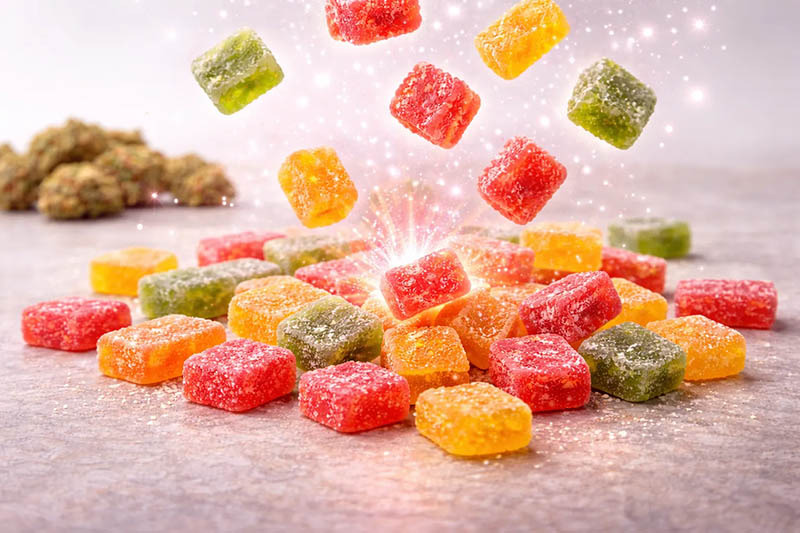
THC gummies typically cause relaxation and euphoria, along with changes in perception. First effects usually appear 30 to 90 minutes after eating, because THC passes through the digestive tract and the liver, and they can last several hours. At high doses, anxiety, paranoia, confusion, a racing heart or nausea can occur, especially when people take more before the first dose peaks.
Key takeaways
THC gummies effects are a frequent topic whenever people talk about cannabis edibles, especially in countries with legalized cannabis for medical or recreational use.[1][2] Many users see them as a discreet way of ingesting cannabis without smoking cannabis or inhaling cannabis smoke.
Because THC gummies are small, colorful and taste like ordinary sweets, it is easy to forget that they contain a psychoactive compound that can negatively affect health, particularly at high doses or with long term cannabis use.[1][3]
Health agencies now treat THC edibles as an important public health issue, since accidental consumption, addiction, and mental health issues have all been reported in connection with cannabis infused edibles and other edible cannabis products.[1][4]
Understanding the effects of THC gummies, including delayed onset, longer duration, and possible adverse effects, helps adults make more informed choices and reduce risk.
Table of contents
THC gummies deliver tetrahydrocannabinol (THC) through the digestive tract rather than the lungs, unlike smoking cannabis or vaping cannabis extract.[1][2] The psychoactive component is absorbed more slowly, then converted in the liver into another psychoactive compound, which can intensify psychoactive effects compared with cannabis smoke at the same cannabinoid dose.[3]
Because edible THC moves through the digestive tract, people may feel nothing for some time, assume they took too little, and then add too much THC, leading to higher THC content in the body than planned. This pattern can cause stronger negative effects such as anxiety, confusion, and in severe cases short-term cognitive impairments or bloodshot eyes.[1][3]
Compared with a single puff of smoking, THC gummies are usually eaten as a food item, sometimes alongside other baked goods or sweet edibles. The combination of tasty THC flavor and slow feedback can make it harder to judge how much THC is already active, especially for many users who are new to ingesting cannabis.
Cannabis edibles cover a wide group of edible products, from traditional baked goods to cannabis infused edibles like chocolates, drinks, and snack bars.[2][3] When people consume cannabis this way, they usually describe it as more comfortable than smoking, because there is no immediate respiratory risk from inhaling hot smoke.
However, cannabis edibles still deliver THC and other cannabinoids to the bloodstream and can increase risk to the cardiovascular system if doses are large, especially in people with underlying heart disease.[1][5] Some research also suggests that very high doses of cannabis edibles may be associated with temporary lung inflammation or respiratory issues if vomiting or aspiration occurs, although this is less common than complications from smoke inhalation.[4]
Edible cannabis can appear in packaging similar to normal food, so label accuracy is crucial. When THC content is not clearly written or is higher than advertised, the chance of accidental ingestion and harmful effects rises.
THC edibles are cannabis edibles designed specifically to contain measurable amounts of THC, and they are often marketed in standardized servings such as 2.5 mg, 5 mg, or 10 mg of THC per piece.[2][3] People often ask how much THC is in a single portion, but real THC content can vary depending on how well the product was manufactured and tested.
Regulators and scientists stress that the psychoactive effects of THC edibles depend on both the single cannabinoid dose and total daily intake. Repeating a dose several times in an evening may quietly create high doses that were never intended, particularly with cannabis infused baked goods and sweet snacks that are easy to keep eating.
Because of delayed onset and longer duration, THC edibles can produce adverse effects like panic, racing heart, or strong disorientation hours after the first bite. In some severe cases medical attention is required, especially when accidental consumption involves children or older adults.[1][4]
THC gummies are one of the most visible forms of THC edibles.[3] They are small gummy or gummy-bear-style sweets flavored with fruit or sour coatings, designed to make the experience feel like eating normal candy.
Manufacturers usually infuse these gummies with cannabis extract or THC distillate and then advertise a fixed THC content per piece. Ideally, the label accuracy should be confirmed by independent testing, but studies have found that some edible cannabis products contain more or less THC than stated, which can negatively affect consumer safety.[3][6]
Because THC gummies look harmless, they are easy to leave on a table or in a bag where others might confuse them with ordinary edibles. Keeping them away from children and clearly separated from non-cannabis sweets is one basic harm-reduction step supported by health agencies.[1][4]
Cannabis use covers many ways people consume cannabis, including joints, vaporizers, cannabis infused edibles, oils, and tinctures. Odor, speed of onset, and dose control differ between these forms, and people often see THC gummies as more discreet than smoking cannabis or vaping.
Unlike smoking cannabis, which exposes lungs to combustion products and carries respiratory risk, ingesting cannabis avoids direct smoke but still introduces THC into the body.[1][2] Recreational use of edibles does not remove risk; it simply shifts it from immediate lung exposure to questions about dose, delayed onset, and interacting health conditions.
Even in regions with legalized cannabis, public health organizations point out that edibles can still cause addiction, mental health issues, or long term cannabis-related complications when used heavily over time.[1][5]
Mental health is central when discussing the effects of THC gummies. THC influences brain signaling, sometimes producing relaxation and euphoria, but in other situations leading to anxiety, paranoia, or disturbing changes in perception.[1][2]
| Type of effect | Examples from this guide |
|---|---|
| Timing | First effects after 30 to 90 minutes; effects can last several hours |
| Common effects | Relaxation, euphoria, changes in perception |
| Unwanted effects | Anxiety, paranoia, confusion, nausea, bloodshot eyes |
| At high doses | Panic, racing heart, strong disorientation, hallucinations |
| With heavy long-term use | Reduced attention span, slower processing speed, memory difficulties, addiction |
Research shows that heavy or long term cannabis use, including high doses of edibles, may be linked to cognitive impairments such as reduced attention span, slower processing speed, and difficulties with memory in some users.[1][3] For adolescents and young adults, whose brain development is still underway, scientists warn of an increased risk of lasting negative effects on learning and mood.
Holistic care for people who struggle with substance use often includes a mental health evaluation and non-drug coping strategies.
Cannabis addiction does not occur in everyone who chooses to consume cannabis, but many users report that stopping regular use is harder than expected.[1][2] THC gummies can contribute to this pattern because they are easy to eat, taste pleasant, and can become part of daily routines.
Over time, repeated cannabis consumption can increase the risk of addiction, especially when THC gummies become part of a daily routine. People may gradually escalate cannabinoid dose, reaching high doses that interfere with work, relationships, or education.
When addiction develops, evidence-based help focuses on counseling, peer support, and sometimes treatment programs that look at the whole person, not just the drug, reflecting a holistic care approach rather than punishment.
Some individuals experience psychotic symptoms such as hallucinations, paranoia, or severe confusion after consuming large amounts of THC.[1][2] This has been reported both with smoked cannabis and with THC gummies, especially when people ingest much more THC than they are used to.
The risk of psychotic symptoms appears higher in people with a personal or family history of psychosis or certain mental health conditions. High doses of THC edibles, particularly in vulnerable individuals, may trigger short-term episodes that require medical attention and, in severe cases, hospital care.[1][4]
Because of these possible harmful effects, health authorities advise that anyone with previous psychotic experiences or strong anxiety disorders avoid high-THC products, including gummies.
CBD edibles are sometimes offered as an alternative to THC gummies and are often described as containing a non intoxicating compound rather than THC. CBD is considered a non intoxicating compound at typical doses, though it is still pharmacologically active and can interact with other medications.[3][7]
Products labeled CBD only can still vary widely in quality and CBD concentration, and some have been found to contain small amounts of THC, raising questions about label accuracy.[3][6] CBD edibles therefore require the same careful reading of labels and awareness of local rules as THC edibles.
Some people combine CBD edibles and THC gummies, hoping that CBD may soften psychoactive effects, but research on how reliably CBD moderates psychoactive component action is still limited.[3][7]
A defining feature of THC gummies is delayed onset. Unlike smoking, where effects may appear within minutes, ingesting cannabis often leads to first sensations 30 to 90 minutes later as THC moves through the digestive tract and is metabolized.[1][3]
This delayed onset can lead people to underestimate how much THC they have already consumed. If they add more gummies before the first dose peaks, the combined THC content may cause stronger psychoactive effects, anxiety, or nausea once everything takes effect.
Because the edible route also produces a longer duration of action, people may continue to feel effects for several hours, which can interfere with driving, work, or other responsibilities even after they feel subjectively better.
Accidental ingestion has become a major concern in public health reports on THC gummies.[1][4] Colorful packaging and sweet flavors make edibles attractive to children, pets, and adults who do not realize a food item contains THC.
Poison centers using the National Poison Data System have documented rising calls about cannabis infused edibles, especially in homes where adults store THC gummies within easy reach.[1] Children with accidental consumption may present with drowsiness, confusion, trouble walking, or respiratory issues, and some severe cases require intensive monitoring.
Case reports suggest similar patterns in other regions, even where cannabis laws differ. Accidental ingestion is therefore not limited to countries with fully legalized cannabis.
Adults can also experience accidental ingestion when THC gummies are mistaken for ordinary edible products at social events, workplaces, or shared housing, which again shows why clear labeling and separate storage matter.
Mainstream health outlets regularly cover the effects of THC gummies, summarizing complex research for general readers, including the adverse effects that can come with inappropriate use.[3][7]
These summaries often draw on peer-reviewed journals such as the International Journal of Molecular Sciences, where Novak and colleagues analyzed how cannabis edibles are formulated and how they behave once ingested.[3] They also refer to poison center data, national surveys, and clinical studies that explore how edibles may negatively affect health.
While these overviews are useful, they cannot replace guidelines from official health agencies or discussions with qualified professionals, especially for people with cardiovascular problems or complex mental health issues.
Despite all the risks, THC gummies and other edibles remain increasingly popular among adults who prefer not to smoke. Some say that edible cannabis fits better with their lifestyle as a discreet food item, while others appreciate what they see as precise dosing and the lack of smoke odor.
Market data point to rapid growth in sales of cannabis edibles, particularly gummies, in regions with legalized cannabis and regulated recreational use.[2] At the same time, public health organizations urge caution, emphasizing that higher availability can lead to more accidental ingestion, more addiction problems, and more emergency visits linked to high doses.
For societies, balancing consumer demand with protection of vulnerable groups such as children and adolescents remains a major policy challenge, especially where resources for monitoring and education are limited.
Many products contain between 2.5 and 10 milligrams per piece, but THC content can vary widely and depends on the manufacturer and local rules.[2][3] People should remember that total cannabinoid dose depends on how many pieces they eat, not just on the number printed on the label.
THC gummies avoid combustion and therefore some of the respiratory risk associated with smoking cannabis or other forms of smoking.[1][2] However, ingesting cannabis still carries risks for the brain, cardiovascular system, and mental health, especially when doses are high or frequent.
Because of delayed onset through the digestive tract, effects may not appear for up to 90 minutes, and the longer duration can extend several hours after that.[1][3] People who add more gummies during the waiting period may accidentally consume too much THC and feel unwell later in the evening.
No medical benefit has been established for these products; they are not a treatment. The same psychoactive effects that cause euphoria can also bring negative effects, including impaired attention span or mood changes. People with a health condition should talk to a qualified professional rather than self-treat.
Health agencies advise that adolescents, pregnant or breastfeeding people, and individuals with serious mental health issues, cardiovascular disease, or a history of psychotic symptoms or suicidal thoughts should avoid high-THC products.[1][2] For these groups, the risk of harmful effects is higher.
The effects of THC gummies arise from a complex interaction between dose, body chemistry, and context. Gummies and other cannabis edibles may feel more approachable than smoking, but they still deliver a psychoactive compound that can cause adverse effects, especially when doses are high or frequent.
Compared with inhaled cannabis, ingesting cannabis brings delayed onset, longer duration, and more uncertainty about how much THC is active at a given time. These features contribute to accidental ingestion, panic reactions, and in some cases addiction or serious mental health complications.
Public health guidance therefore emphasizes moderation, careful storage, and informed decision-making. Even in environments where cannabis use is legal, professionals stress that no level of THC exposure is completely risk-free and that support is available for people who want to reduce or stop their use.
World Health Organization – Cannabis
https://www.bmj.com/content/364/bmj.l574
European Monitoring Centre for Drugs and Drug Addiction (EMCDDA) – Cannabis and cannabinoids
https://www.euda.europa.eu/topics/cannabis_en
Novak SP et al. “Tasty THC: Promises and Challenges of Cannabis Edibles.” Int J Mol Sci.
https://www.mdpi.com/1422-0067/21/2/515
National Institute on Drug Abuse (NIDA) – Marijuana Research Report
https://nida.nih.gov/research-topics/cannabis-marijuana
Centers for Disease Control and Prevention (CDC) – Marijuana and Public Health
https://www.cdc.gov/marijuana/index.htm
American Academy of Pediatrics – Marijuana Use and the Developing Brain
https://www.aap.org/en/patient-care/marijuana/
Medical News Today – Can You Eat Weed? All You Need to Know About Marijuana Edibles
https://www.healthline.com/nutrition/eating-weed
Canadian Centre on Substance Use and Addiction – Cannabis
https://www.ccsa.ca/en/guidance-tools-resources/substances/cannabis?field_areas_of_expertise_target_id=10361