Shopping Cart
There are no more items in your cart

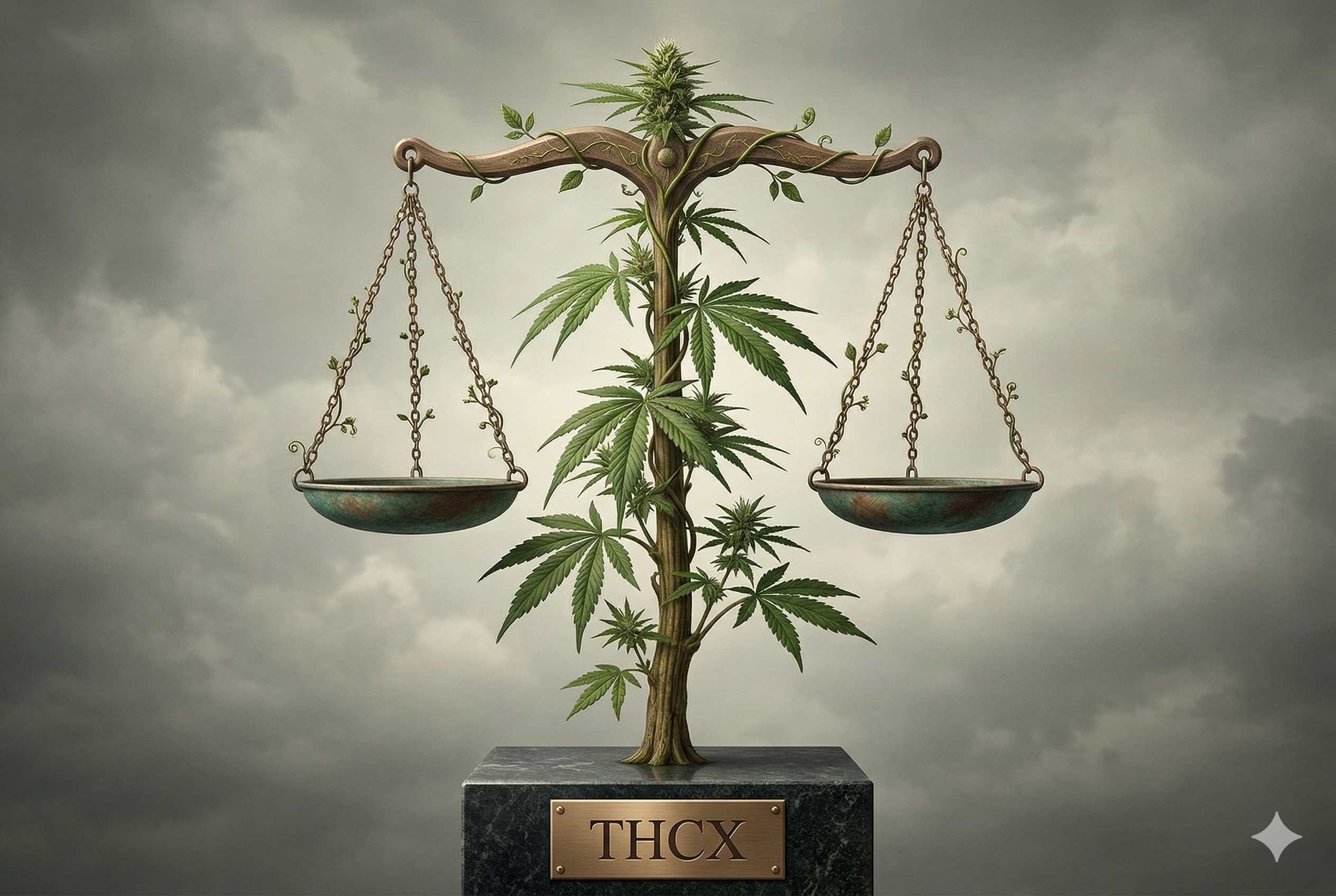
There is no single answer to whether THCX is legal: its status depends on the actual composition of the product, how it was made, the jurisdiction and the date. In the EU, the 0.3% THC limit applies to hemp crops, not automatically to finished or chemically altered products, and in the United States federal hemp rules can still be restricted by states. THCX can also cause a positive drug test.
Key takeaways
THCX is a label that has started to circulate in the cannabis industry and in the wider cannabis market, especially around hemp derived cannabinoids sold as legal alternatives to traditional THC. The first thing to understand is simple: the name THCX is not a well-settled scientific term, and the exact composition of THCX products may vary depending on the manufacturer, the process, and the cannabinoid blend being used. [1] [2]
That uncertainty is why people ask, is THCX legal, rather than only asking how strong it is. Legal status, psychoactive properties, drug tests, current legislation, and product chemistry all matter because a product can be sold as hemp-derived while still containing psychoactive substances or a synthetic cannabinoid profile that raises separate regulatory concerns. [1] [2] [4]
This article explains what THCX usually means, how it may relate to delta 8 THC, why some sellers describe a unique chemical structure, and why limited research still makes many claims hard to verify. It also covers legal questions, adverse effects, health claims, and the practical issue of whether a person could test positive after using THCX. [1] [2] [5]
Table of contents
Whether THCX is legal is not a question with one universal answer. In practice, the legal status depends on the source material, the chemistry used to make the product, the jurisdiction, and whether regulatory bodies treat it as one of the hemp derived cannabinoids or as a synthetic derivative with separate controls. [1] [2] [4]
In the EU, hemp plants used in agriculture must come from approved varieties and stay below the 0.3% THC threshold for the crop. That rule is real, but it does not automatically settle the legal status of finished cannabis products made from extracts or chemically altered cannabinoids. [3] [4]
In the United States, many people frame the issue around whether a hemp-derived product is federally legal. That can still leave room for state-level restrictions, enforcement differences, and uncertainty around psychoactive cannabinoids created through chemical conversion rather than taken directly from the cannabis plant in a naturally occurring form. [1] [2] [4]
So the safest answer is narrow: THCX may be marketed as legal in some places, but such claims are not reliable unless the exact composition and local law are both checked carefully; a trade name is not legal advice. [1] [2] [4]
The name THCX is best understood as a market label. It is not a standard pharmacological category in the same sense as delta 9 THC or CBD, and many cannabinoids sold under new labels are described more confidently in marketing than in research. [1] [2]
That matters because one company may use the name THCX for a cannabinoid blend built from converted CBD, while another may use it for a different mix of psychoactive substances. The name THCX by itself does not prove what is inside the package. [1] [2]
This is one reason the phrase THCX cannabinoid should be used carefully. It can imply a single defined compound, even though the product may actually be a blend or mixture that only shares branding language. [1] [2]
THCX is often presented as a new cannabinoid. That description partly reflects the fast-moving cannabis industry continues to create and market novel derivatives, but it does not always mean the underlying science is new, settled, or well studied. [1] [2]
Some products are described as being derived from CBD through conversion into delta 8 or related forms, followed by further processing. That places them closer to a synthetic cannabinoid or semi-synthetic category than to naturally occurring cannabinoids taken directly from the cannabis plant without substantial modification. [1] [2]
This distinction is important because natural cannabinoids and psychoactive cannabinoids do not all raise the same legal or safety questions. Products built through chemical manipulation can face a different response from regulatory bodies than simple extracts from hemp plants. [1] [2] [4]
Sellers sometimes describe THCX as having a unique chemical structure. That may refer to chemical esters, cannabinoid esters, or another synthetic nature created by altering a precursor such as delta 8 THC. [1] [2]
The problem is that the exact composition is not always clearly disclosed. Without third-party analysis, a consumer may not know whether the product contains one dominant synthetic derivative, many cannabinoids, trace amounts of several compounds, or another cannabinoid blend entirely. [1] [2]
That is why the words chemical structure should not be treated as proof of quality. A claimed unique chemical structure can still hide uncertainty about purity, identity, and consistency across batches. [1] [2]
Some descriptions mention chemical esters specifically. In general, that suggests a process of chemical modification rather than simple extraction from the cannabis plant in its raw state. [1] [2]
Like other cannabinoids, THCX is promoted as interacting with the body's endocannabinoid system. This system includes cannabinoid receptors that help regulate appetite, mood, pain signaling, and other functions. [5] [6]
The body's cannabinoid receptors, especially CB1 receptors in the central nervous system, are relevant because psychoactive effects usually depend on how strongly a compound activates them. The body's endocannabinoid system is also the reason people sometimes speculate about health effects, which remain unproven. [5] [6]
Still, limited research means these claims remain tentative. Knowing that a product may interact with cannabinoid receptors does not prove a safe or beneficial outcome in real-world use. [1] [2] [5]
Delta 8 THC is important to this topic because many descriptions of THCX connect it to delta 8 as a starting point. EUDA notes that semi-synthetic cannabinoids in Europe are often produced from CBD extracted from hemp plants. [1] [2]
That means delta 8 THC may be part of the pathway by which some THCX products are made. A seller can then frame the result as THC x, delta x, or another new cannabinoid label, even though the product may still be chemically related to other hemp derived cannabinoids already on the market. [1] [2]
This does not automatically make the product illegal. It does mean that delta 8, delta 8 THC, and related converted substances are relevant when asking whether THCX legal status is actually stable. [1] [2] [4]
Delta 9 THC remains the main benchmark for psychoactive cannabis. It is the traditional THC most people mean when they talk about marijuana, recreational use, or the core intoxicating component of medical cannabis. [5] [6]
A THCX product may be marketed as staying below the delta 9 THC threshold while still producing psychoactive effects. That is one reason low delta 9 THC alone does not settle the legal status or practical risk of a product. [1] [2] [4]
Traditional THC is also useful as a comparison point. Some users describe THCX as milder than traditional THC, others as stronger than delta 8, and others as simply different. Several factors explain that variation, including dose, route of use, cannabinoid blend, and individual preferences. [1] [2] [5]
THCX sits in a broader family of other cannabinoids sold across the cannabis market. These include CBD, delta 8, delta 9 THC, HHC-like compounds, and many cannabinoids created or modified during processing. [1] [2]
Common cannabinoids such as CBD and delta 9 THC are better studied than newer labels like THC x. That difference matters because the better-known cannabinoids have clearer toxicology, pharmacology, and legal history than emerging psychoactive cannabinoids. [1] [2] [5]
The rise of other cannabinoids also helps explain why the cannabis industry continues to generate consumer confusion. Products can look similar on shelves while differing sharply in composition, safety, and potential adverse effects. [1] [2]
THCX is usually marketed for psychoactive properties. Reports from vendors and users often emphasize psychoactive effects such as enhanced sensory perception, increased energy, euphoric effects, and a mood shift that can feel different from both CBD products and traditional THC. [1] [2] [5]
Because THCX is described as one of the psychoactive substances in the new-cannabinoid space, it should not be approached like a neutral wellness product. Psychoactive cannabinoids can alter reaction time, judgment, and coordination even when the user feels in control. [5] [6]
The exact psychoactive effects can vary depending on dose, form, and formulation. Vape liquids and vape cartridges may produce faster onset than oral forms, which can make the experience feel more abrupt. [5]
Many sellers imply that THCX is mainly for experienced users. That idea has some logic because products with stronger psychoactive properties or more uncertain composition can be harder to dose safely. [1] [2]
Even so, experienced users are not immune to problems. If a product has an uncertain exact composition or stronger-than-expected psychoactive effects, previous cannabis experience may not translate cleanly. [1] [2] [5]
Low doses remain the safer starting point. For any product with an unclear cannabinoid blend, low doses reduce the chance of unpleasant reactions and make it easier to judge the actual potency. [5]
Health claims about THCX are common online, but they are speculation rather than evidence. [1] [2] [5]
The endocannabinoid system is involved in many body functions, but that does not show that THCX has any medical effect. There is limited research on THCX itself. [5] [6]
The same applies to medical cannabis comparisons. A product being psychoactive does not make it equivalent to regulated medical cannabis, and it does not prove safety or efficacy for treatment. [5]
No medical benefit has been established for these products; they are not a treatment. [1] [2] [5]
Adverse effects are one of the most important parts of the discussion. Cannabis-related psychoactive substances can cause dry mouth, anxiety, impaired coordination, dizziness, confusion, and other potential side effects, especially at higher doses. [5] [6]
Potential adverse effects may also include paranoia or overstimulation. A product marketed as cleaner or more modern than traditional THC can still produce a bad reaction if the dose is high or the chemistry is unclear. [1] [2] [5]
Dry mouth is a familiar signal of cannabinoid intoxication. It is not the most dangerous reaction, but it often appears alongside stronger psychoactive effects. [5]
Because THCX may involve a synthetic nature or synthetic derivative chemistry, uncertainty itself becomes a risk factor. Adverse effects are harder to predict when consumers do not know exactly what the product contains. [1] [2]
Drug tests are a practical reason many people ask whether THCX is legal. A product can be marketed as hemp-derived and still create trouble if it triggers a workplace or roadside result. [7]
Standard drug tests often look for THC metabolites rather than for a product name. One common marker is THC-COOH, which is associated with cannabis exposure. [7]
That means a user may test positive after using THCX even if the label emphasizes hemp plants or low delta 9 THC. In practical terms, a hemp-derived label does not guarantee a clean drug test result. [7]
So yes, THCX could lead someone to test positive. Anyone subject to screening should assume that risk is real. [7]
The legal status of THCX differs by region. In the United States, some products are marketed as federally legal if they are derived from hemp plants and stay within federal hemp rules. [3] [4]
But federally legal does not mean universally allowed. States may restrict psychoactive hemp products or reclassify a synthetic derivative based on current legislation. [1] [2] [4]
In Europe, the legal status is also fragmented. EU agriculture rules say hemp varieties must remain below 0.3% THC, but EUDA has repeatedly noted that low-THC and semi-synthetic products raise separate legal questions. [1] [3] [4]
This is why claims that THCX is legal should always be treated as provisional. A product can be sold in the cannabis market while still facing later scrutiny from regulatory bodies. [1] [2] [4]
| Rule or context | What it covers | What it means for THCX |
|---|---|---|
| EU hemp rules | Approved varieties below 0.3% THC for the crop | Do not automatically settle the status of finished or altered products |
| US federal hemp rules | Products derived from hemp within federal limits | States may restrict psychoactive hemp products or reclassify a synthetic derivative |
| Rules on synthetic cannabinoids | Compounds made by chemical conversion | May apply if authorities treat THCX as a synthetic derivative |
| Drug testing | THC metabolites such as THC-COOH | A hemp-derived label does not prevent a positive test |
THCX legal status depends on how the product is defined by current legislation. If authorities see it as part of the hemp-derived sector, one set of rules may apply. If they see it as a synthetic cannabinoid or another psychoactive substance outside normal hemp expectations, a different set of rules may apply. [1] [2] [4]
This is also why the question of whether THCX is legal cannot be answered with one sentence for every jurisdiction. The same THC X products could be tolerated in one place and challenged in another. [1] [2] [4]
Regulatory bodies are still catching up. More research and clearer definitions would help, but right now the legal status remains partly unsettled in many places. [1] [2]
THCX products appear in various forms. Common examples include vape cartridges, vape liquids, infused flower, concentrates, and edible-style formats. [1] [2] [5]
THC X products may also be marketed under different branding that highlights hemp derived cannabinoids, sensory perception, or increased energy. That language can make products sound standardized when they may not be. [1] [2]
CBD products are relevant here because they are often the starting point for conversion. A product can begin as CBD and end as a psychoactive cannabinoid blend with very different effects. [1] [2]
The words hemp derived cannabinoids can therefore be technically true while still leaving out important context about the synthetic nature of the final product. [1] [2]
Sometimes the safest interpretation is that the name THCX functions partly as a marketing gimmick. That does not prove every product is fake, but it does mean the name alone should not be treated as scientific evidence. [1] [2]
The phrase marketing gimmick matters because new labels can make old or familiar chemistry seem more advanced than it is. A company can emphasize a unique chemical structure, an origin story, or futuristic branding without providing enough independent proof of composition. [1] [2]
Even when a company story exists, consumers still need third-party data rather than mythology. [1] [2]
In short, if the name THCX is doing more work than the lab sheet, skepticism is warranted. [1] [2]
No. The legal status of THCX varies by jurisdiction and over time, and may depend on whether a product is treated as hemp-derived, semi-synthetic, or a synthetic cannabinoid. [1] [2] [4]
Not automatically. Hemp origin helps explain the source material, but the final product and its chemistry still matter for legal status. [1] [2] [4]
It is marketed for psychoactive effects and psychoactive properties, so users should assume it may intoxicate. [1] [2] [5]
No. There is limited research on THCX itself and more research is needed. No medical benefit has been established for these products; they are not a treatment. [1] [2] [5]
Yes. Drug tests may detect THC-COOH or related metabolites, so a person could test positive after use. [7]
No. It may be related to traditional THC or delta 8 THC pathways, but it is usually marketed as a separate new cannabinoid or cannabinoid blend. [1] [2]
The best answer to whether THCX is legal is cautious rather than absolute. THCX sits at the intersection of hemp derived cannabinoids, psychoactive substances, and unsettled regulation, which means the legal status can shift depending on law, chemistry, and enforcement. [1] [2] [4]
Its appeal comes from psychoactive effects, novelty, and the suggestion that it is one of the legal alternatives to standard cannabis. But the same features that make it interesting also make it uncertain. [1] [2]
For consumers, the practical priorities are clear: understand the exact composition, check current legislation, assume drug tests are a real risk, and be careful with low doses because limited research still leaves major unanswered questions. [1] [2] [5] [7]
That is a more reliable guide than any bold claim that THCX is simply legal, natural, or safer than other cannabinoids. [1] [2]
Official reference: EUDA: semi-synthetic cannabinoids in Europe.