Shopping Cart
- -5%
- New
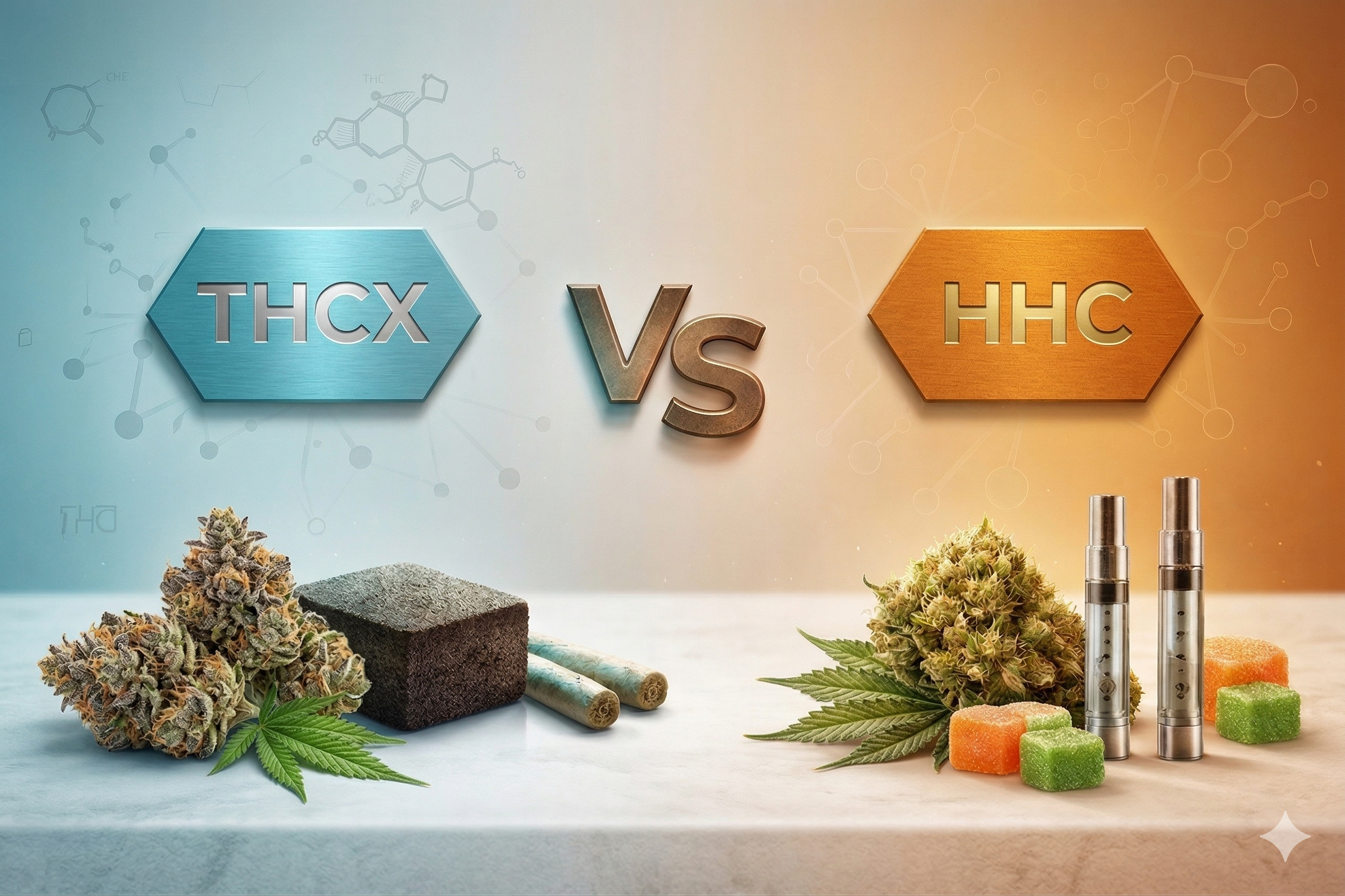
THCX vs HHC is now a common comparison in the cannabinoid market because both names are presented as modern alternatives to traditional THC. Many users want to know whether these compounds come from hemp derived products, how strong their psychoactive effects are, whether they are safer than classic cannabis products, and how their legal status differs across markets.
The confusion is understandable. HHC, or hexahydrocannabinol, is a known semi-synthetic cannabinoid that drew major attention in Europe and France before being controlled. HHC is a minor cannabinoid naturally present in the cannabis sativa plant in small amounts, but it is typically synthesized from hemp-derived cannabinoids via a hydrogenation process, which allows it to be legally produced under the 2018 Farm Bill. THCX, by contrast, is usually a market label rather than a clearly standardized scientific compound. That difference matters because the name on a package does not always reveal the exact composition, the synthesis process, or the real safety profile.
This article explains THCX vs HHC in clear terms. It covers hhc and thc, psychoactive properties, legal status, adverse effects, cannabinoid receptors, consumption methods, drug testing, and the role of the body’s endocannabinoid system. It also addresses where THCX may be marketed as a legal alternative, why HHC became restricted, and why further research is still needed for both compounds.
The goal is harm reduction. These are intoxicating cannabinoids, and both safety concerns and regulatory uncertainty remain important. Even when products are sold as hemp products or other hemp derived cannabinoids, that does not automatically make them low risk, federally legal everywhere, or clearly compliant with national law.
THCX vs HHC is not just a comparison between two names. It is also a comparison between two different kinds of uncertainty. HHC is a better documented hydrogenated derivative of THC, while THCX is often marketed as a new product label that may refer to a cannabinoid blend, a modified formula, or other hemp derived cannabinoids with unclear exact composition.
This is why many users ask about perceived potency, psychoactive effects, and legal status before they ask about flavor or product form. In practical terms, THCX may be sold as one of the legal alternatives to cannabis, while HHC is already a controlled substance in many European states and is banned in France.
It is important to note that "THC derived" from marijuana is federally classified as a Schedule I controlled substance in the United States, though many states permit its medical and recreational use. This legal status differs from that of hemp-derived or synthetic cannabinoids like HHC, which may be regulated differently depending on jurisdiction.
A second difference concerns evidence. HHC has been formally reviewed by European and WHO-linked bodies. THCX has not been established with the same clarity. So while both may be discussed in the same cannabis market, HHC compared with THCX usually rests on stronger public documentation.
Understanding the chemistry and structure of HHC and THC is key to grasping how these cannabinoids differ in their effects and interactions with the human body. HHC, or hexahydrocannabinol, is classified as a hydrogenated derivative of THC. This means that HHC is created through a hydrogenation process, where hydrogen atoms are added to the THC molecule. As a result, the molecular formula of HHC becomes C₂₁H₃₂O₂, compared to THC’s C₂₁H₃₀O₂. The addition of two hydrogen atoms may seem minor, but it significantly alters the molecular structure.
This structural change impacts how HHC and THC interact with the body’s endocannabinoid system, particularly with cannabinoid receptors CB1 and CB2. The modified molecular structure of HHC can influence its binding affinity and the way it activates these receptors, which are responsible for many of the psychoactive effects and physiological responses associated with cannabinoids. While both HHC and THC engage the endocannabinoid system, the hydrogenation process can result in subtle differences in how users experience their effects, including onset, duration, and intensity.
For consumers, these chemical distinctions are not just academic. They help explain why HHC and THC may produce different psychoactive effects, and why safety concerns can vary between the two. Understanding the molecular structure and the role of hydrogen atoms in creating a hydrogenated derivative like HHC provides a clearer picture of how these cannabinoids function within the body and why their legal and safety profiles may differ.
HHC vs traditional THC is one of the most important comparisons because HHC and THC share a close relationship in chemical origin. HHC is a hydrogenated derivative of THC. In simple terms, the hydrogenation process alters the molecular structure by adding hydrogen atoms to THC-related material. Specifically, this process involves adding hydrogen molecules to THC, which transforms it into HHC and affects its stability and potency. This changes the molecular formula and chemical structure enough to create a new compound while preserving many intoxicating effects associated with THC.
Unlike THC in its classic form, HHC is usually produced synthetically or semi-synthetically, even though it occurs naturally only in trace amounts. That is why HHC is generally discussed alongside synthetic cannabinoids or semi-synthetic cannabinoids rather than alongside naturally occurring cannabinoids from the cannabis plant alone.
This matters for users seeking a legal alternative. A product can be closely related to traditional THC in psychoactive properties while still being treated differently under federal law, EU rules, or national legislation.
Legal status is where the THCX vs HHC comparison becomes especially important. In France, HHC and related compounds were added to the narcotics list in June 2023. That means HHC legal is no longer a valid description for France. Production, sale, and use are prohibited there.
Across Europe, HHC is now listed as a controlled drug in at least 22 EU Member States as of February 2025, and in March 2025 the UN Commission on Narcotic Drugs voted to place it under the same regulations as delta 9 THC. So the legal status of HHC has moved sharply away from the earlier image of a legal alternative.
THCX is harder to classify. In many cases, THCX appears to be a marketing label for hemp derived cannabinoids or modified formulas, not a standardized primary psychoactive compound recognized in the same way as delta 9 THC, CBD, or HHC. That means THCX legal claims should be treated carefully. The exact composition, local law, and whether the product contains synthetic cannabinoids or other hemp derived cannabinoids all matter.
In the United States, some products are marketed as federally legal if they come from hemp and remain below the legal delta 9 thc threshold. But federal law does not settle every case, and the Drug Enforcement Administration has taken interest in chemically converted cannabinoids. So users should never assume that hemp origin alone guarantees legality.
HHC compared with THCX is easier to discuss when looking at stability and production. HHC is known for greater chemical stability than some traditional THC products. The hydrogenation process adds hydrogen molecules and reduces the reactivity of the original compound, which can make HHC less vulnerable to UV radiation and oxidation.
This higher stability is one reason HHC gained attention in the cannabinoid market. It was presented as a practical option for products requiring shelf life and consistency. THCX, by contrast, is often sold through branding language about innovation, special formulas, or enhanced psychoactive properties, but the exact composition may differ from product to product.
So when people ask hhc compared with THCX, the answer is partly chemical and partly commercial. HHC is better documented as a hydrogenated derivative. THCX is more variable and may refer to a range of hemp products rather than one clearly defined compound.
Cannabinoids HHC belong to the broader category of intoxicating cannabinoids now circulating in the cannabis market. These include delta 8 THC, delta 9 THC, HHC, HHC derivatives, and many other cannabinoids marketed as hemp derived cannabinoids or alternatives to marijuana plants and traditional THC products.
Some of these compounds are produced through conversion from CBD. Others are fully or partly produced synthetically. This creates a moving landscape in which consumers may encounter products sold as natural, hemp-based, or legal, even when the synthesis process has altered the original material significantly.
That is why safety concerns are not limited to one molecule. The broader field of synthetic cannabinoids and semi-synthetic cannabinoids includes multiple compounds with different potency, purity, and risk profiles.
Psychoactive properties are central to the THCX vs HHC discussion. HHC produces intoxicating effects broadly similar to cannabis and THC products, according to laboratory and animal data summarized by EUDA. Human data remain limited, but many users report mild euphoria, relaxation, and altered sensory perception.
THCX is often marketed as offering intense psychoactive effects, balanced effects, or milder effects than traditional THC depending on the seller. Because THCX is not standardized, users report a wider range of experiences. Some report intense psychoactive effects and altered perception. Others describe something closer to functional uplift or mild euphoria. That variability itself is part of the risk.
Psychoactive cannabinoid products act through cannabinoid receptors in the body’s endocannabinoid system. That includes CB1-linked mechanisms associated with euphoria, intoxication, and cognitive impairment. HHC interacts with the body’s endocannabinoid system by binding to CB1 and CB2 receptors, similar to THC. This is why both HHC and THCX should be treated as psychoactive substances, not as neutral wellness compounds.
HHC and THC are closely related in effect profile. HHC produces intoxicating effects that many users compare with THC, although often with a somewhat different balance of onset, duration, or clarity. Some users describe HHC produces milder effects than delta 9 THC, while others say the difference becomes small at higher doses.
Unlike THC in regulated cannabis products, HHC is often found in hemp derived products and marketed as separate from traditional marijuana plants. But this distinction does not eliminate the risk of cognitive impairment or adverse effects. It mainly changes the regulatory and manufacturing context.
This is one reason the phrase hhc and thc matters so much. The relationship explains both HHC’s appeal and the concern that surrounded it. If it behaves similarly enough to THC to intoxicate, regulators may treat it more like THC than like non-intoxicating CBD.
HHC legal used to be a common marketing angle. That angle no longer works in France, and it has weakened across Europe. As of 2025, HHC is controlled in most EU Member States, which means HHC legal claims must be checked carefully against local law.
In other regions, confusion continues because some sellers still refer to HHC as one of the hemp derived cannabinoids permitted under hemp frameworks. But regulation has clearly moved toward control, not acceptance.
For users seeking a legal alternative, this is a critical takeaway: HHC’s earlier legal image is outdated in many places.
Consumption methods shape both perceived potency and adverse effects. Both HHC and THCX can appear in vape products, oils, edibles, concentrates, and infused hemp products. Recreational users may also encounter them in gummies or cartridges marketed as convenient hemp products.
Inhaled products usually act faster, while edibles act more slowly but can last longer. This difference matters because intense psychoactive effects are easier to overshoot with delayed products, especially for experienced users who assume tolerance will transfer across compounds.
Users seeking balanced effects should therefore pay close attention to dose, onset time, and route of use. These individual factors often matter more than the branding language on the package.
The cannabinoid market continues to evolve fast. The cannabis market now includes not only traditional THC products and CBD, but also a long list of other cannabinoids, hemp derived cannabinoids, and semi-synthetic compounds.
This fast growth is one reason many users compare THCX vs HHC. The cannabis market continues to produce new labels faster than many regulators and researchers can evaluate them. That creates room for innovation, but also for confusion, marketing overreach, and lower risk claims that may not hold up.
The result is a landscape where users seeking alternatives must evaluate not just the molecule, but also the synthesis process, the source material, and the testing practices behind the product.
Potential benefits are often part of the sales narrative for both compounds. Some users and manufacturers mention pain relief, stress reduction, sleep support, and milder effects compared with traditional THC.
But the evidence gap is important. Further research is still needed for HHC, and even more so for THCX. Public sources do not support strong medical claims for either product at this stage.
So while potential benefits may exist, especially if a product interacts with the body’s endocannabinoid system in predictable ways, the current state of knowledge supports caution rather than confidence.
Other cannabinoids matter because THCX and HHC do not exist in isolation. Delta 8 THC, delta 9 THC, CBD, THCP, and many other cannabinoids shape how users interpret potency and compare products.
This also affects consumer expectations. A user who knows CBD products may expect lower risk and milder effects. A user familiar with marijuana plants may compare everything back to the primary psychoactive compound in cannabis, which is delta 9 THC. But HHC and THCX each sit somewhere else on that spectrum.
That is why both HHC vs THC and THCX vs HHC remain useful comparisons. They help users understand where each product sits relative to other hemp derived cannabinoids and intoxicating cannabinoids.
Negative effects include dry mouth, dizziness, anxiety, altered perception, and cognitive impairment. Higher doses increase the risk, especially with poorly characterized products or those containing residual solvents from the synthesis process.
Residual solvents are a real concern for produced synthetically compounds because inadequate purification can leave unwanted material behind. That is one reason independent testing matters for HHC, THCX, and similar hemp derived products.
Potential risks also include stronger-than-expected intoxicating effects, lower risk assumptions that prove wrong, and altered sensory perception that affects coordination or judgment. Unlike THC in regulated cannabis products, some hemp products may have less consistent oversight.
Many users assume that newer compounds are automatically cleaner or gentler. That assumption is unsafe. Negative effects can still be serious, particularly for recreational users, users seeking intense psychoactive effects, or people mixing products.
The main difference is that HHC is a documented hydrogenated derivative of THC, while THCX is usually a less standardized market label. HHC’s chemistry and legal history are clearer than THCX’s.
Not necessarily. THCX is often marketed as having intense psychoactive effects, but its exact composition can vary. HHC compared with THCX may feel milder in many cases, but there is no single rule for all products.
HHC legal depends on jurisdiction, but in France it is banned, and across Europe it is controlled in most Member States.
Yes. Like other intoxicating cannabinoids, both HHC and THCX may create metabolites associated with THC exposure. THC-COOH is a common marker in drug testing.
There is not enough evidence to say that. Safety concerns remain, especially around produced synthetically products, residual solvents, inconsistent potency, and limited human research.
THCX vs HHC is ultimately a comparison between two intoxicating cannabinoids with different levels of clarity. HHC is better documented, but now heavily restricted. THCX is less defined and more variable, which makes its legal status and safety profile harder to judge.
For users, the key questions are practical. What is the exact composition? Was the product produced synthetically? Are there residual solvents? Is the legal status stable where you live? Those questions matter more than whether the label promises mild euphoria, balanced effects, or a legal alternative to traditional THC products.
In short, both HHC and THCX belong to a rapidly evolving cannabinoid market where chemistry, law, and marketing do not always move together. That is why careful reading, independent testing, and low-risk decision-making remain the best approach.