
Shopping Cart
- On sale!
- -50%
Out-of-Stock
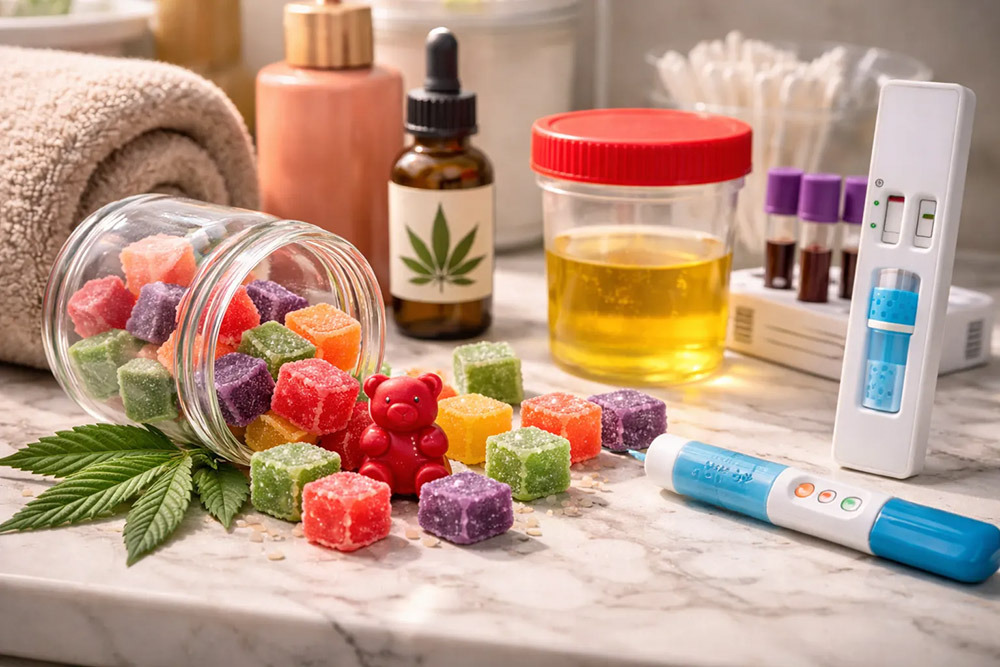
Do THC gummies show up on drug tests? Yes. THC gummies, marijuana edibles, and other cannabis edibles can all lead to a positive drug test because most drug tests detect THC or THC metabolites after the human body processes the edible. A person may test positive even after the main high and many residual effects have faded. [2][3]
This is one reason THC gummies cause anxiety for people with a drug test coming. Edibles use a different route than smoking marijuana, smoking cannabis, or smoking weed, but they are not hidden from testing. THC enters the digestive system, moves through the digestive tract, and is metabolized before labs detect THC in urine, blood, saliva, or hair. [1][3][4]
The detection window depends on several factors and other factors, including THC use, dose, higher doses versus lower dose exposure, body fat, fat cells, frequency of marijuana use, and the type of drug test. The system depends on how the body processes THC, not on whether the product looked like a candy or was taken as one of many THC edibles. [2][3][4]
THC gummies are cannabis edibles made with tetrahydrocannabinol, the main psychoactive compound in cannabis. Like other marijuana edibles and THC edibles, they are swallowed rather than inhaled, so the body handles them differently from smoking marijuana or smoking cannabis. [1][3]
They are popular because they are discreet, easy to carry, and easier for some people to portion than flower or joints. But that convenience can raise red flags for users who assume that taking edibles instead of smoking weed means a drug test will not detect THC. It still can. [2][3]
Some users also compare THC gummies with hemp derived THC products, THC free products, CBD gummies, and other cannabinoids sold in edible form. That comparison matters because trace amounts and trace amounts of THC in mislabeled products can affect drug test results. [6][8]
After taking edibles, THC enters the digestive system and moves through the digestive tract before reaching the liver. This is different from smoking marijuana, where THC reaches the blood much faster through the lungs. [3][4]
Once in the liver, THC is converted into active and inactive metabolites. One important reason edibles can feel stronger is that oral THC produces 11-hydroxy-THC, which is often described as more potent than the THC experienced after inhalation. That is part of why some users say the more potent the THC feels with edibles compared with smoking cannabis, especially at higher doses. [3][4]
As body processes continue, the body forms THC metabolites such as THC-COOH. These THC metabolites are what most urine tests and many urine drug test programs are trying to find. That means a positive test usually reflects prior exposure, not necessarily current impairment. [2][3]
Yes, THC gummies can absolutely show up on drug tests. A standard drug test, especially a urine drug test, is designed to detect THC exposure by looking for THC metabolites after the edible has been processed by the human body. [2][3]
This is true for THC gummies, THC edibles, marijuana edibles, and cannabis edibles more broadly. The fact that the product was eaten does not prevent a positive result. A person can still test positive on most drug tests if the lab cutoff is exceeded. [2][3][4]
The question “do THC gummies show up on drug tests” often comes from occasional users, infrequent users, and people with a drug test coming after one weekend dose. Even one exposure can produce a positive drug test, though the detection window is usually shorter than in heavy users or frequent or heavy users. [2][3][6]
A drug test can use urine, blood, saliva, or hair. Each type of drug test has a different goal, a different cutoff, and a different detection window, so drug test results can vary even for the same person. [2][3][4]
Urine tests are the most common workplace option. Most drug tests in employment settings use urine because urine stays positive longer than blood or saliva in many cases. Urine tests generally look for inactive THC metabolites, not current intoxication. [2][3]
A urine drug test often detects marijuana stay patterns longer than users expect. In monitored abstinence studies, urine remained positive for days or longer depending on prior THC use, metabolite concentration, and frequency of use. This is especially relevant for frequent or heavy users and heavy users. [3][6]
A blood test usually has a shorter window than urine, but blood test positivity can still occur after oral cannabis exposure. Controlled oral-cannabis studies found measurable THC in blood into the first day after use, though blood usually reflects a shorter period than urine. [4]
Saliva tests, also called oral fluid tests, usually focus on recent exposure. They often have a shorter detection window than urine tests, but they can still detect THC after taking edibles, especially in the first day after use. [4]
Hair tests are used as a long-window approach. Hair tests may reflect repeated cannabis exposure over weeks or months, though they are not ideal for proving the exact moment of use. [3]
How long THC gummies stay in your system depends on dose, frequency, metabolism, and the type of drug test. For many users, the most important issue is not how long the effects last, but how long the metabolites stay in your system after the high is gone. [3][4]
Urine often shows the longest routine window in workplace screening. In infrequent users and occasional users, detection can be shorter, while heavy users and frequent or heavy users may remain positive much longer. Some monitored abstinence data found urinary positivity extending into the second week for higher groups, with longer persistence possible in some cases. [3][6]
Blood and saliva usually show shorter windows than urine, while hair tests can reflect use over a much longer period. So the answer to long THC detection is not one number. The system depends on the matrix used and on various factors inside the body. [3][4]
Several factors influence whether a person gets a positive test or a positive result.
Frequency of marijuana use is one of the biggest. Occasional users and infrequent users usually clear faster than heavy users. Frequent or heavy users tend to have longer excretion of THC metabolites. [3][6]
Dose also matters. Higher doses usually mean more THC, more metabolites, and a better chance that a test will detect THC for longer. A lower dose may reduce the window, but it does not eliminate risk. [3][4]
Body composition matters too. THC is lipophilic, so body fat and fat cells can store cannabinoids and release them gradually. That is one reason THC levels and the time compounds stay in your system vary between people. [3]
The digestive tract and digestive system matter because oral cannabis follows a slower route than inhalation. THC enters the stomach and intestines first, then the liver, and only after that do body processes create the metabolites seen in common testing. [3][4]
Other factors include pre existing medical conditions, other substances, other drugs, lab sensitivity, and the exact type of drug test. Even two people with the same dose may not get the same drug test results. [2][3]
Full spectrum CBD products may contain trace amounts of THC. Those trace amounts can matter because repeated use of full spectrum CBD may, in some situations, add enough THC exposure to affect a urine drug test. [8]
CBD gummies are not automatically risk-free. Pure CBD appears unlikely to cause a THC-positive result by itself, but CBD gummies made with full spectrum CBD or poorly labeled hemp derived THC ingredients can still create problems. [8][9]
Broad spectrum CBD is generally marketed as having no THC or very little THC, but broad spectrum products still depend on accurate manufacturing and labeling. If a product is contaminated or mislabeled, broad spectrum CBD may not be as THC free as expected. [8]
CBD isolate is usually considered lower risk for testing because it is intended to contain CBD without THC. Even so, experts still emphasize product quality, because the safety of CBD isolate for drug testing depends on whether the product is truly pure. [8][9]
CBD products vary widely. Some contain other cannabinoids, some contain trace amounts, and some are sold as broad spectrum or THC free without perfect quality control. That is why CBD products can sometimes raise red flags in testing conversations, even when the label suggests otherwise. [8]
Broad spectrum, broad spectrum CBD, and broad spectrum products are often discussed as safer choices for testing than THC gummies, but “safer” does not mean guaranteed. If the product contains trace amounts of THC, the risk is reduced, not eliminated. [8]
THC gummies can produce a positive result because tests look for THC or its metabolites. Detection varies with the test, product, amount, frequency of use and individual biology; there is no universal window that guarantees a negative result.
Hydration, exercise, mouthwash, “detox” products and changing how THC is consumed cannot reliably defeat a properly administered test. This article does not provide instructions for altering samples or evading workplace, clinical or legal testing.
If testing is required, follow the responsible organization’s instructions. People using prescribed cannabinoid medicines should use the organization’s disclosure or medical-review process; CBD or hemp labelling does not by itself guarantee that a product cannot affect a test.
Testing policy is not the same everywhere. Legal status varies across Europe, and workplace rules can differ from general cannabis policy. A positive result can therefore have different consequences depending on the setting. [7]
For employment, the key point is that many workplace programs use urine drug test screening and focus on prior exposure rather than real-time impairment. That creates tension because a positive test may document past THC use without proving that the person is currently impaired. [2][7]
This matters for medical purposes too. Even where cannabis has some medical purposes in law or regulation, a workplace drug test may still follow its own policy. So legal status and employer rules should never be treated as the same issue. [7]
Yes. THC gummies can show up on drug tests because the human body converts THC into THC metabolites that standard screening methods can detect. [2][3]
It can. One use is less risky than repeated use, but one exposure can still produce a positive drug test depending on the dose, timing, and test sensitivity. [2][3]
They can. Marijuana edibles and other cannabis edibles follow a slower metabolic path than smoking marijuana or smoking cannabis. The effects and detection profile are different, and metabolites can still remain detectable after the felt effects are gone. [3][4]
Pure CBD is less risky, but CBD gummies made with full spectrum CBD, hemp derived THC, or contaminated broad spectrum products may still contain trace amounts of THC and could lead to a positive test. [8][9]
There is no proven guaranteed method to flush THC quickly. Detox kits and similar claims should be treated cautiously. The safest approach is allowing enough time and avoiding THC use before the test. [2][3]
Do THC gummies show up on drug tests? Yes. THC gummies, marijuana edibles, and other THC edibles can all produce a positive test because labs detect THC metabolites after the body processes the edible. [2][3]
The exact detection window depends on several factors, including dose, frequency, body fat, fat cells, metabolism, and type of drug test. Urine tests usually last longer than blood test or saliva tests, while hair tests can extend the window much further. [3][4][6]
For anyone worried about a drug test coming, the clearest takeaway is that edibles are not a loophole. Whether the product was a gummy, another snack, or one of many drugs or cannabis products, the body still processes THC in a way that can be detected later. [2][3]
Official references: SAMHSA: drug-testing resources; U.S. DOT: CBD and positive drug-test notice.